Starting with GetRecruited takes a few minutes: you enter a few details, land on a recruiting plan built around your athlete, and read the first step free before you decide anything. Here's what that looks like — and how to work the plan once you're in.
The signup flow (a few minutes)
Signing up at GetRecruited takes three short steps:
Enter your email. We'll send a 6-digit verification code.
Enter the code. That signs you in.
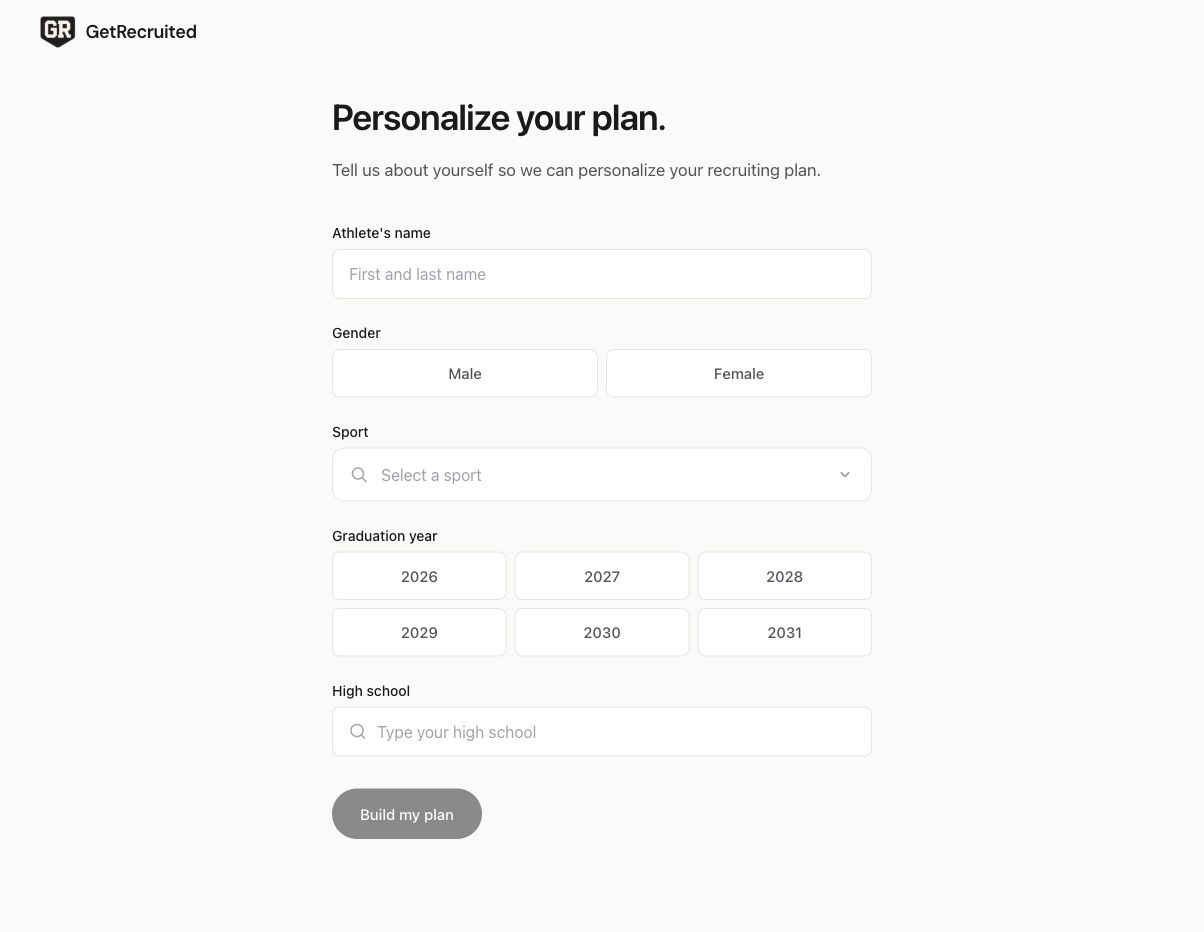
Fill out a short profile. Athlete name, gender, sport, graduation year, and high school.
After clicking Build my plan, you'll land on your personalized recruiting plan. The tools later in the journey ask for the context they need — your fit-level inputs, your target programs, your offers — at the moment you actually use them.
What you get after signup
After signing up, you land on your full recruiting plan: every step in order across four stages — set your foundation, build your recruiting file, build coach relationships, compare and commit — for fifteen steps in total, with five tools (Fit Estimator, Program Finder, Email templates, Net Cost Calculator, Decision Scorecard) sitting inside the steps that need them.
The first step is unlocked free so you can read the overview before deciding anything else. The other fourteen steps and the tools sit behind a $100 unlock that you pay once and keep for life. If it isn't useful for your family within fourteen days, send us an email and you get your $100 back, no questions asked.
Reading is good. A plan is better.
Tell us your sport and grad year. We’ll return a sequenced playbook with every step, tool, and program you need — in one place.
Those 15 steps run across four stages, and each one has a short read, then — where it applies — a tool to actually do the work, not just learn about it.
A reasonable starting rhythm:
First couple of sessions: Read How college recruiting works. Then run the Fit Estimator and start the target list with the Program Finder. Lock down the academic requirements step. By the end of this you'll have a defensible target level and the beginning of a real list.
Then a few weeks: Set up the recruiting profile, get the right video for your sport, and ask your current coaches to advocate for you.
Then the long stretch: Reach out to college coaches, learn to read their signals, pick the right camps, and prepare for campus visits. This is where consistency matters most — a few focused hours a week over many months.
Finally: Compare any offers honestly with the Net Cost Calculator, run the Decision Scorecard, and handle what comes after commitment.
The full process — from signup to a confident commit — usually runs 12–24 months. Some sports compress that (early-recruiting sports like soccer) and some give families more runway (later-recruiting sports like track or rowing). Late-start athletes (juniors or seniors who didn't start recruiting earlier) move faster through the first stages and focus most of their effort on coach relationships, often with a heavier emphasis on programs with later recruiting calendars (D2, D3, NAIA, JUCO).
If you get stuck
Most stuck points fall into a few patterns:
You can't decide on a target level. Talk to outside coaches in your sport — your high school coach, club director, or a private coach who's seen athletes in your range commit to college programs. The Fit Estimator gives a starting range; external feedback helps confirm or adjust it.
The target list is too big or too small. Re-apply the four filters (athletic, academic, financial, personal). Most lists shrink to a focused short list after honest filtering. If yours stays sprawling, the filters aren't tight enough. If yours collapses to a handful, the filters may be too tight or the level needs to broaden.
Coaches aren't responding. Audit the four likely causes: the target list is above the athlete's level, the materials need work, the timing is off for the sport's recruiting calendar, or the emails aren't specific enough to each program. Each of those has its own step in the plan to diagnose against.
The product itself isn't working for you. The 14-day refund exists for this case. If GetRecruited doesn't match how your family wants to run recruiting after two weeks of honest use, send us an email and you get your $100 back.
Starting is the hard part
Everything in the plan is built to be done a little at a time — but none of it begins until the first sitting does. Read the free first step, and within an afternoon you'll know whether this is how your family wants to run recruiting. The families who get their athletes recruited aren't the ones who research the most. They're the ones who start, and keep going.