By GetRecruited
Introduction
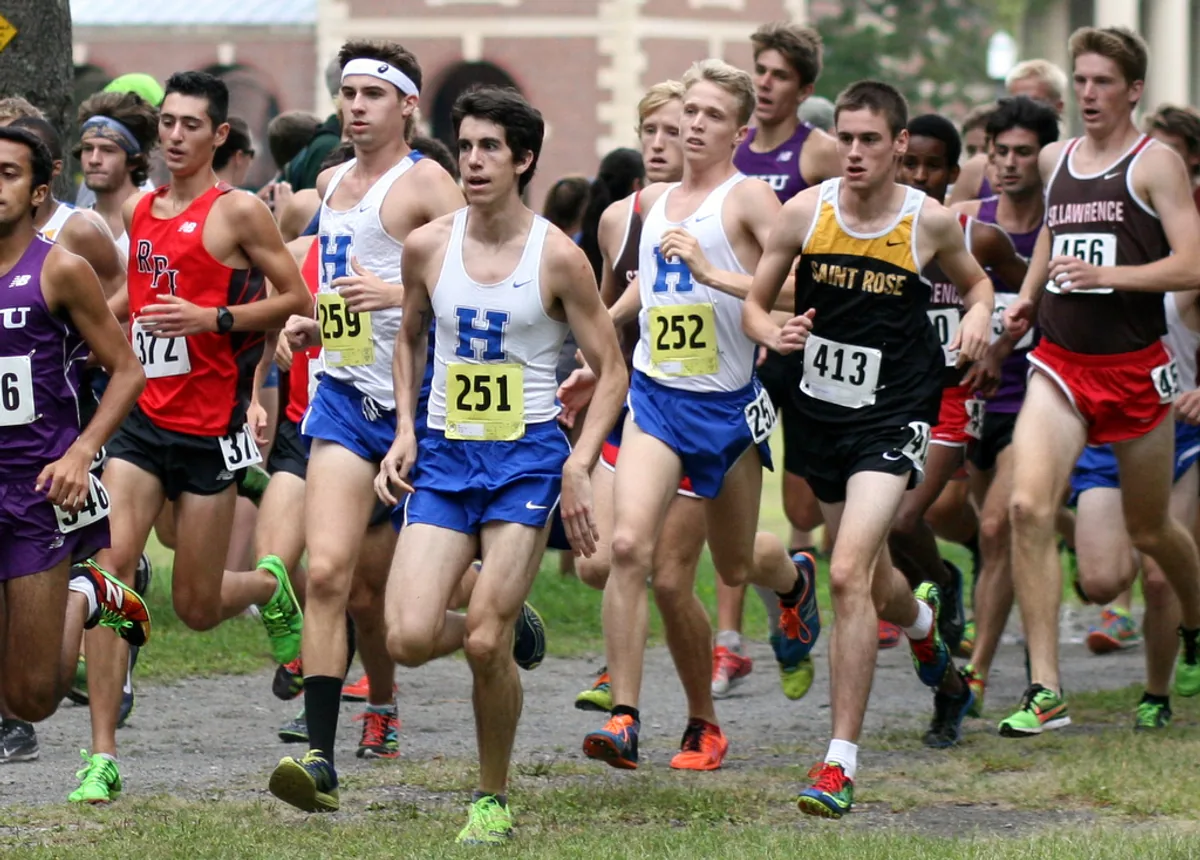
On race day, a cross country team's score is the sum of where its top five finishers cross the line, and the low total wins. The sixth and seventh runners still matter, pushing rival scorers further back in the field. Nobody sits the bench. Everyone races, and a freshman who runs the day of his life can swing the result as hard as the team's number one.
That math shapes how coaches recruit. A coach isn't filling one slot at one position; he's deepening a pack and hunting for the next runner who can crack the scoring five or hold the line just behind it. Your times do most of the talking before he ever watches you race, which is why families who know where to send those times have an edge.
There are 1,307 men's cross country programs, spread across five divisions and 53 states and territories, carrying about 12 runners apiece. Most run far from any broadcast — and a runner who'd sit deep on a famous bench could be a scoring five at one of them.
Best colleges
Search for best cross country colleges and you'll get a ranking. Recruiting doesn't work that way. The best cross country college is the one where your level, your grades, your budget, and a real shot at playing time all line up at once — and that school is different for every recruit.
So treat the sections below as filters, not a leaderboard. Each one sorts the field by a single thing that decides fit — how the divisions break down, how fast rosters turn over, what the degree is worth, and what a year really costs — and the full men's cross country directory lets you weigh them against your own priorities, program by program.
The 1,307 programs below sort into five very different worlds. A recruiting plan turns that field into a shortlist matched to your times, your grades, and your family's budget — built from the data, not from the names you already know.
Landscape
D3 fields the most teams; a D1 bench runner might score every week there instead.
The programs split across five competitive levels, and the largest group isn't the one most families picture first. Division III leads at 390 programs — 30% of the sport. Division I, the level you see at the NCAA championships, holds 331 programs, or 25%. Division II adds 264 (20%), the junior colleges 212 (16%), and the NAIA — a separate association of smaller four-year colleges — accounts for 110 (8%).
So three out of four men's cross country programs run somewhere other than Division I. A runner who would be a deep-bench walk-on at a big D1 might be a top-five scorer at a strong D3 or NAIA program, racing every weekend instead of redshirting a year. The level that fits your current times is usually the one that puts you on the line the most.
Programs sit where the colleges are, and the colleges are densest in the populous states. California has the most at 115, then New York with 108 and Pennsylvania with 93. Illinois (57), Texas (55), Massachusetts and Ohio (50 each), and Michigan (49) fill out the top of the list. The five biggest states together hold about a third of every program in the sport.
Geography weighs less here than in most sports. A cross country season is a travel season — you race invitationals, conference meets, and regionals wherever they're scheduled — so where a program sits tells you more about the campus you'd live on than the courses you'd run. If you're willing to leave home, the college-heavy Northeast and Midwest hold as many programs as the warm-weather states do.
Roster size
Seven score, and the scoring five keeps changing.
A cross country roster is small by design. Only seven men race in a scoring lineup, and squads average about 12 across the sport — 14.4 at D1, 14 at D3, 13.4 at D2, 11.7 at NAIA, and 8.7 at the junior colleges. Those averages run a little high: the median D2, D3, and NAIA program carries 10 or 11, with a handful of deep teams pulling the mean up.
A small squad isn't a sealed door, because distance running turns over faster than the headcount suggests. Seniors graduate, runners step away, and a four-year program refills roughly a quarter of its squad every season. That works out to about three to four newcomers per program a year at the four-year levels — call it 1,192 openings a year across D1, 885 across D2, and 1,362 across D3.
Junior colleges run on a two-year clock, so they reload faster: roughly 922 spots open across JUCO programs each year despite the smaller squads. None of these counts is a guarantee — a team loaded with returning underclassmen may have little room, while one losing its top five is wide open. But the shape holds. Across all five divisions, the sport opens several thousand roster spots every year.
| Division | Programs | Avg roster | Open spots, total | Open spots, pr. program |
|---|---|---|---|---|
| D1 | 331 | 14.4 | 1,192/year | 3.6/year |
| D2 | 264 | 13.4 | 885/year | 3.4/year |
| D3 | 390 | 14.0 | 1,362/year | 3.5/year |
| NAIA | 110 | 11.7 | 321/year | 2.9/year |
| JUCO | 212 | 8.7 | 922/year | 4.3/year |
Averages hide a wide spread, though. Within a single division squads swing hard: some D3 programs carry a single runner while Wartburg fields 65, and even at D1 the range runs from 1 to the mid-30s. A deep squad isn't automatically more opportunity — it can mean more runners chasing the same scoring five, sometimes a walk-on-everyone model rather than a recruited pack. The number worth checking is a specific program's roster against the size of its last recruiting class.
Best cross country roster opportunities, by division
| Program | Roster |
|---|---|
| Saint Mary's College of California West Coast Conference | 34 |
| Siena College Metro Atlantic Athletic Conference | 28 |
| University of California-Santa Barbara Big West Conference | 25 |
| University of Tulsa American Conference | 24 |
| Santa Clara University West Coast Conference | 22 |
| Longwood University Big South Conference | 22 |
| Purdue University Fort Wayne Horizon League | 20 |
| Merrimack College Metro Atlantic Athletic Conference | 20 |
| Robert Morris University Horizon League | 20 |
| Jacksonville State University Conference USA | 19 |
Academics
Serious academics line up behind the start, top to bottom.
Two numbers tell you most about a school's academics. The graduation rate is the share of students who finish their degree; six-year earnings is roughly what graduates make a few years out of college. Across the divisions, graduation rates run from 66% at D1 and 64% at D3 down to 50% at D2 and 43% at NAIA, with the junior colleges at 36% — lower partly because JUCO is built as a two-year stepping stone, not a finish line. First-year retention, the share of freshmen who come back as sophomores, follows the same order: 82% at D1, 78% at D3, and down from there.
Those are averages, and they hide the best of each level. In Division I, Harvard graduates 98% of its students and Penn 97%, with Stanford close behind at 92%. But Division III holds Caltech (94% graduation, $132,140 in six-year earnings), MIT (96%, $131,633), and Carnegie Mellon (94%) — schools whose graduates out-earn almost anything in D1.
The pattern reaches into the smaller associations. Among NAIA programs, Soka University of America graduates 92% of its students; among the junior colleges, Emory's Oxford College reaches 94%. The lesson for your family: the division shorthand is a poor stand-in for academic quality. A program three levels below the championship broadcast can carry one of the best degrees in the entire sport.
Best academic cross country colleges, by division
| Program | Acceptance rate | Graduation rate | Median earnings |
|---|---|---|---|
| Harvard University The Ivy League | 4% | 98% | $99,572 |
| University of Pennsylvania The Ivy League | 5% | 97% | $90,555 |
| Stanford University Atlantic Coast Conference | 4% | 92% | $102,887 |
| Columbia University in the City of New York The Ivy League | 4% | 96% | $88,535 |
| Princeton University The Ivy League | 5% | 98% | $87,815 |
| Duke University Atlantic Coast Conference | 6% | 97% | $85,792 |
| Dartmouth College The Ivy League | 5% | 96% | $82,541 |
| Yale University The Ivy League | 4% | 96% | $81,765 |
| Cornell University The Ivy League | 9% | 95% | $87,830 |
| University of Notre Dame Atlantic Coast Conference | 11% | 95% | $86,210 |
Cost
The tuition gap is about the campus, not the course.
Net price is what a family actually pays per year after grants and scholarships come off the sticker — the number that matters more than published tuition. Averaged by division, the figures land closer together than the labels suggest: $21,334 at D1, $19,236 at D2, $24,775 at D3, $19,600 at NAIA, and $8,705 at the junior colleges, where local tuition keeps the bill low.
The sharper line runs between public and private. Across the whole sport, public programs average $13,023 a year after aid; private ones average $26,274 — roughly double. That gap is wider than the spread between any two divisions, and it holds inside each level: a public D1 averages $15,965 while a private D1 averages $30,889. A state university, whatever division it races in, will usually cost your family less than the private college down the road.
The full range is enormous. At the low end, public junior colleges run a few thousand dollars a year; at the high end, some private programs clear $45,000 after aid. Two schools at the same competitive level can sit $20,000 apart in what they ask of your family — which is why net price belongs on your list right next to the coach's recruiting standards, not somewhere after them.
Average net price per year, after grant and scholarship aid
There's a quiet assumption that the cheap option is the lesser one — that a low price buys a weaker school. The programs below are the counter-evidence. Each pairs one of the lowest net prices in its division with a degree worth finishing, and nearly all of them are public: the D1 floor sits around $5,282 (UT Rio Grande Valley), CUNY schools stack the D3 list near $4,000, and a public JUCO like George C. Wallace lands close to $476 a year.
Best-value cross country colleges, by division
| Program | Net price | Graduation rate |
|---|---|---|
| The University of Texas Rio Grande Valley Southland Conference | $5,282 | 51% |
| University of New Mexico-Main Campus Mountain West Conference | $6,347 | 54% |
| California State University-Fullerton Big West Conference | $7,064 | 70% |
| California State University-Northridge Big West Conference | $7,536 | 57% |
| California State University-Fresno Mountain West Conference | $7,834 | 57% |
| Marshall University Sun Belt Conference | $8,076 | 51% |
| Utah Valley University Western Athletic Conference | $8,721 | 40% |
| Norfolk State University Mid-Eastern Athletic Conf. | $9,124 | 39% |
| Northern Kentucky University Horizon League | $9,211 | 54% |
| The University of Texas at El Paso Conference USA | $9,305 | 50% |
The programs that fit both your son's times and your family's budget make a shorter list than it first looks. A recruiting plan weighs net price, aid, and academic fit together — so you spend your effort on the schools that make sense, not the ones with the loudest name.
Resources
Big budgets, thin scholarship lines.
Program spend is what a school pours into its men's cross country team in a year — athletic scholarships plus everything else, from travel to coaching to meet entries. The divisions sit at very different scales. A typical D1 program spends about $221,235; D2 runs $106,823, NAIA $109,555, and JUCO $46,415. Division III spends roughly $43,533 — and by NCAA rule, none of it can be an athletic scholarship.
That last point catches families off guard every year: Division III awards no athletic scholarships at all. A D3 coach can recruit you hard and want you badly, but any aid in your package comes from academics and financial need, never from running. If a scholarship for the sport anchors your plan, treat D3 as a fit for the school and the racing, not for athletic money.
Where athletic aid does exist, the per-runner picture reshuffles the order. D1 leads at about $19,049 of athletic aid per roster spot. But NAIA comes in second at $7,675 — ahead of D2's $6,025 — and the junior colleges average $2,590. For a runner weighing scholarship dollars, NAIA programs can match, and beat, the bigger D2 names that look more prestigious on paper.
Average spending per year, by division
So the question isn't only who offers a scholarship, but how much per runner, and from where. A D1 spot carries the most athletic aid on average, but it's also the hardest to earn and the most likely to be split thin across a roster. An NAIA program with $7,675 per spot may put more real money in front of a mid-pack recruit than a D2 program will. And at D3, the strongest offer usually comes through the financial-aid office rather than the coach — which means your grades and your family's finances drive it more than your times do.
Average athletic aid per roster spot, by division
These are the heaviest spenders in each division — the programs putting the most into their men's cross country each year. Total spend is the whole operation; the scholarship column shows how much of it reaches runners directly, the line between a travel-and-coaching budget and a scholarship-first one. The D1 ceiling runs past $1.1 million a year (Santa Clara), though NAIA's top (Savannah College of Art and Design, near $697,000) outspends most of D1 — a reminder the biggest budgets don't all wear D1 letters. D2 and the heaviest JUCO budgets top out around $430,000, and D3 — which can spend on everything but scholarships — under $170,000.
Best-resourced cross country programs, by division
| Program | Total spend | Scholarships |
|---|---|---|
| Santa Clara University West Coast Conference | $1,142,079 | $438,925 |
| Stanford University Atlantic Coast Conference | $558,760 | $748,822 |
| Vanderbilt University Southeastern Conference | $549,603 | $717,555 |
| Temple University American Conference | $540,743 | $377,520 |
| Merrimack College Metro Atlantic Athletic Conference | $487,339 | $446,873 |
| Saint Mary's College of California West Coast Conference | $479,741 | $610,576 |
| Seton Hall University BIG EAST Conference | $422,125 | $405,533 |
| University of Tulsa American Conference | $418,874 | $884,615 |
| Siena College Metro Atlantic Athletic Conference | $366,314 | $393,003 |
| Mercer University Southern Conference | $352,083 | $377,717 |
Hold these numbers together and the instruction is plain: read the budget for what it tells you about a program's reach, then return to the things that actually decide your year — the open spots, the aid per runner, the net price, and the degree. The school with the biggest number isn't automatically the one with the best offer for you.
Conclusion
For a cross country recruit, the most useful takeaway is also the most freeing: the letter beside a program decides less than it seems. Three-quarters of the sport runs outside D1. The best degrees and the lowest prices turn up at every level, often in the same school. And athletic aid follows public-versus-private and per-runner math far more than it follows the division line.
So the search is wider and more forgiving than the championship broadcast makes it look — but the work is still yours to do. The runner who lands in the right program isn't the one with the fastest 5K alone; he's the one who matched his times, his grades, and his family's budget to a coach who needed exactly that, at a school he was glad to spend four years at. The data narrows the field. The next step is yours.
You've seen the whole field — the divisions, the openings, the cost, the aid. A recruiting plan narrows it to the programs that fit your son's times, his grades, and your family's budget, and lays out who to contact and when. Build the plan, then start sending times to the coaches who actually have room.
Methodology
Roster sizes and program finances come from the Equity in Athletics Data Analysis (EADA) reports that colleges file each year — the source for squad counts, athletic scholarship dollars, and total program spend. Cost, graduation rate, first-year retention, post-college earnings, and admissions figures come from the U.S. Department of Education's College Scorecard and IPEDS, which compile what students actually pay and how they fare after enrolling. Estimated open spots are modeled from average roster turnover: roughly a quarter of a four-year squad each season, half of a two-year junior college squad.
Every figure is computed within men's cross country specifically, division by division, so a D2 average reflects D2 men's cross country programs rather than a school's athletics overall. Named programs carry the exact values reported in those filings. Figures reflect the most recent reporting year available; schools update their filings annually, so individual numbers will shift over time.
U.S. Department of Education. Athletic participation and program finances, filed annually by every college.
U.S. Department of Education. Cost, graduation, earnings, and admissions data.
Official season records and results for NCAA D1, D2, and D3.