By GetRecruited
Introduction
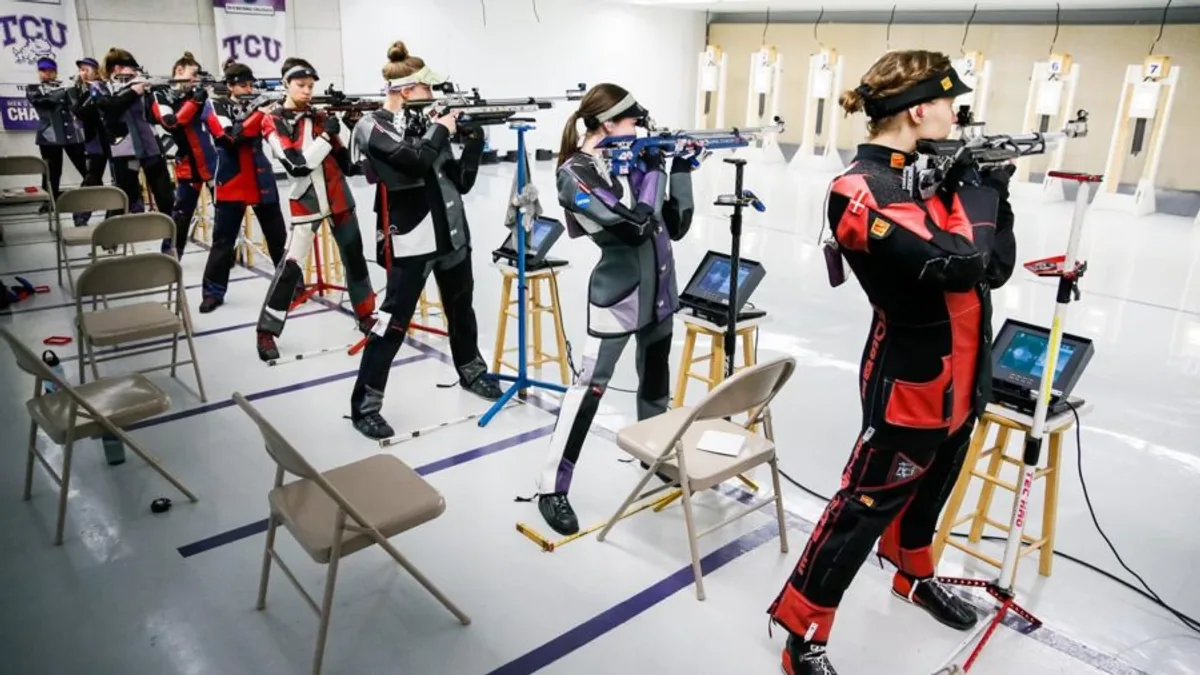
Rifle is one of the smallest varsity sports in the country, and one of the most unusual: it's scored coed. Men and women fire the same course of fire and chase the same national title, so a recruit isn't choosing between a men's and a women's program — there's one sport, and we cover all of it here in a single report.
Counted that way, there are just 12 college rifle programs, spread thinly across 10 states. That scale changes the whole search: this isn't about narrowing a long list, it's about knowing the short one cold — who competes, what kind of school each is, and what it would cost your family to be there.
Twelve programs is a list a family can know cold — every school, every cost, every team — which is the whole advantage in a sport this small, where no one else has bothered to lay it in front of you.
Best colleges
Search for best rifle programs and you'll get a ranking. Recruiting doesn't work that way. The best rifle program is the one where your level, your grades, your budget, and a real shot at playing time all line up at once — and that school is different for every recruit.
So treat the sections below as filters, not a leaderboard. Each one sorts the field by a single thing that decides fit — how the divisions break down, how fast rosters turn over, what the degree is worth, and what a year really costs — and the full college rifle directory lets you weigh them against your own priorities, program by program.
With a field this small, the move isn't to filter — it's to target. Build a recruiting plan and we'll help you figure out which of these programs fits your scores, your grades, and your budget, and how to reach each coach.
Landscape
Twelve teams, and most of the weight sits in Division I.
Of the 12 college rifle programs, seven compete in Division I, one in Division III, and four at the two-year junior-college (JUCO) level. There's no broad mid-major middle here — the sport is essentially a small cluster of D1 programs with a handful of two-year teams below them. Among the D1 names are SEC and national powers like Nebraska, Ole Miss, and TCU, alongside two of the sport's most distinctive members: the Citadel and Virginia Military Institute, where rifle sits naturally inside a service-academy culture.
The level still tells you the rules. Division I and JUCO programs can put athletic scholarship money behind a shooter; the lone Division III program, by NCAA rule, awards none — aid there is academic or need-based only. JUCO is the two-year, lower-cost route, useful for developing before a transfer.
Because rifle is coed, a recruit's options aren't split by gender — every one of these teams is open to you, and the right question is simply which program fits your scores and the school you want.
With only 12 programs, geography is less a map than an address book. Texas carries the most at three (including TCU), and the rest scatter across Georgia, Iowa, Illinois, Michigan, Mississippi, Nebraska, South Carolina, Virginia, and Wisconsin. A shooter will almost certainly be looking out of state, so plan early for travel — both for recruiting visits and for a family that wants to watch matches.
Roster size
Small squads, and only a seat or two opens a year.
Rifle rosters are tiny — programs average about 9 shooters, similar at the D1 level and at the two-year colleges. A team that small turns over only a seat or two a year at the four-year programs, so openings are scarce and timing is everything; the JUCO programs, on a two-year cycle, refill faster.
Across the whole sport that's roughly 16 D1 openings a year, close to 19 at the JUCO level, and the occasional D3 spot. The honest read for a recruit: a roster number doesn't promise a vacancy, and with so few seats, the question to a coach is blunt — are you recruiting a shooter in my class year, and at what scores?
| Division | Programs | Avg roster | Open spots, total | Open spots, pr. program |
|---|---|---|---|---|
| D1 | 7 | 9.0 | 16/year | 2.3/year |
| D2 | 0 | — | — | — |
| D3 | 1 | 7.0 | 2/year | 1.8/year |
| NAIA | 0 | — | — | — |
| JUCO | 4 | 9.3 | 19/year | 4.6/year |
Even across a sport this small, roster size swings more than the average suggests. Southwest Wisconsin Technical College carries 18 shooters and Ole Miss 13, while the Citadel and a few others sit at five. A deeper squad isn't more opportunity — it's more shooters competing for the same lineup spots. With seats this scarce, the number worth checking is a program's roster against how many shooters it's actually recruiting in your class year.
Best rifle roster opportunities
| Program | Roster |
|---|---|
| Southwest Wisconsin Technical College NJCAA (Region Unspecified) | 18 |
| University of Mississippi Independent | 13 |
| Texas Christian University Patriot League | 11 |
| Virginia Military Institute Southern Conference | 11 |
| Iowa Lakes Community College Iowa Community College Athletic Conference | 9 |
| Georgia Southern University Southern Conference | 8 |
| The University of Texas at El Paso Patriot League | 8 |
| University of Nebraska-Lincoln Independent | 7 |
| Schreiner University Southern Collegiate Athletic Conference | 7 |
| Rend Lake College | 5 |
Academics
Strong degrees, and the service academies lead them.
For a sport this small, the academic outcomes run high — and the standouts are a distinctive group. TCU graduates 85% of its students with median earnings around $60,435 six years after they enroll (that earnings figure is a rough read on where a degree leads). The two military colleges are right there with it: VMI graduates 76% at about $63,545, and the Citadel 75% at $60,168 — among the strongest earnings in the sport, and a reminder that rifle's service-academy programs are serious academic homes.
Below the D1 group the picture is more mixed — the lone D3 program, Schreiner, graduates 43%, and the JUCO programs land in between (Southwest Wisconsin Technical College at 66%, Rend Lake at 63%) — which is normal for two-year schools where many students transfer on to finish elsewhere. As always, read each program on its own record rather than its level.
Best academic rifle programs
| Program | Acceptance rate | Graduation rate | Median earnings |
|---|---|---|---|
| Texas Christian University Patriot League | 45% | 85% | $60,435 |
| Southwest Wisconsin Technical College NJCAA (Region Unspecified) | 100% | 66% | $42,360 |
| Virginia Military Institute Southern Conference | 71% | 76% | $63,545 |
| Citadel Military College of South Carolina Southern Conference | 23% | 75% | $60,168 |
| Iowa Lakes Community College Iowa Community College Athletic Conference | 100% | 50% | $37,209 |
| University of Nebraska-Lincoln Independent | 88% | 67% | $47,692 |
| Schreiner University Southern Collegiate Athletic Conference | 88% | 43% | $45,527 |
| Rend Lake College | 100% | 63% | $29,814 |
| University of Mississippi Independent | 97% | 72% | $45,336 |
| Georgia Southern University Southern Conference | 88% | 55% | $44,423 |
Cost
A wide price spread, driven by public versus private.
Net price — what a family actually pays per year after grants and aid, not the sticker — varies more than you'd expect across just a dozen schools, and the swing is the public/private line, not the level. Inside D1 that gap is stark: a public school there averages $16,599 while TCU, private, runs $41,848. The two-year colleges are the cheapest way in, averaging $11,945.
The military colleges are the value story. VMI, public, lands at $18,825 a year with one of the highest graduation-and-earnings combinations in the sport — an unusually strong return for the price. The takeaway holds even at this scale: check whether a program's school is state-funded before you judge the bill.
Average net price per year, after grant and scholarship aid
There's a quiet assumption that the cheap option is the lesser one. Rifle's lowest net prices are the counter-evidence — and every one of them is public. UTEP nets out near $9,305, and among the two-year colleges Southwest Wisconsin Technical College runs $14,272 against a 66% graduation rate. The standout for value is VMI: a public service academy pairing a strong price with one of the highest graduation-and-earnings combinations in the sport, 76% finishing and about $63,545 in graduate earnings. Value isn't the lowest number — it's a strong outcome you didn't overpay for.
Best-value rifle programs
| Program | Net price | Graduation rate |
|---|---|---|
| Mid Michigan College Michigan Community College Athletic Association | $8,803 | 28% |
| The University of Texas at El Paso Patriot League | $9,305 | 50% |
| Rend Lake College | $11,427 | 63% |
| Iowa Lakes Community College Iowa Community College Athletic Conference | $13,278 | 50% |
| Southwest Wisconsin Technical College NJCAA (Region Unspecified) | $14,272 | 66% |
| University of Mississippi Independent | $15,045 | 72% |
| Georgia Southern University Southern Conference | $15,971 | 55% |
| University of Nebraska-Lincoln Independent | $18,322 | 67% |
| Virginia Military Institute Southern Conference | $18,825 | 76% |
| Citadel Military College of South Carolina Southern Conference | $22,124 | 75% |
Across this small field the price swings by tens of thousands depending on the school and your aid. Build a recruiting plan and we'll help you line up each program by what it would actually cost your family.
Resources
At the top, the scholarship money is real.
Even in a sport this small, the Division I programs are funded like serious operations. The average D1 rifle program spends about $661,211 a year, with roughly $266,501 of that in athletic scholarships and the rest on coaching, travel, ranges, and equipment. Divide the aid across those small rosters and a D1 spot draws about $28,399 in athletic money on average — a meaningful figure for a recruit who can compete at that level.
Step below D1 and the money thins fast: the lone D3 program awards no athletic aid by rule, and the JUCO programs spend a fraction of the D1 figure. The scholarship opportunity in rifle is concentrated almost entirely in that handful of D1 teams.
Average spending per year, by division
Per roster spot, the divide is clean: about $28,399 in athletic aid at the average D1 program, a token amount at the JUCO level, and nothing at D3 by rule. These are averages, not offers — what any one coach can assemble depends on the program and the year — but they show the scholarship money in rifle lives at the D1 level and essentially nowhere else.
Average athletic aid per roster spot, by division
These are the heaviest spenders in the sport — the programs putting the most into rifle each year. Total spend is the whole operation; the scholarship column shows how much of it reaches shooters directly, the line between a range-and-travel budget and a scholarship-first one. Nebraska spends the most at $1,783,568, but only $167,270 of that is scholarship — the rest is coaching, ranges, and a national travel schedule. TCU runs a different model: $904,192 total with $577,710 of it going to athletes as aid.
Best-resourced rifle programs
| Program | Total spend | Scholarships |
|---|---|---|
| University of Nebraska-Lincoln Independent | $1,783,568 | $167,270 |
| University of Mississippi Independent | $1,049,980 | $488,621 |
| Texas Christian University Patriot League | $904,192 | $577,710 |
| Georgia Southern University Southern Conference | $400,252 | $137,388 |
| The University of Texas at El Paso Patriot League | $303,564 | $224,497 |
| Citadel Military College of South Carolina Southern Conference | $127,869 | $137,586 |
| Virginia Military Institute Southern Conference | $59,051 | $132,435 |
| Iowa Lakes Community College Iowa Community College Athletic Conference | $42,061 | $19,638 |
| Schreiner University Southern Collegiate Athletic Conference | $37,736 | — |
| Rend Lake College | $37,193 | $17,662 |
A big budget signals a program that can compete and support a shooter well; it doesn't promise a roster spot or a fit. With a field this small, the better use of these numbers is to understand which programs are resourced to develop you — then weigh that against the school itself.
Conclusion
Rifle asks a different question than most recruiting searches. There's no long list to cut down — there are 12 programs, most of them Division I, a few at the two-year level, one at D3, and a coed format that puts every team on the table no matter who you are. The money and the strongest competition sit in that D1 cluster; the best value and a service-academy path run through schools like VMI and the Citadel.
For a family, the work is less about discovery than about precision: know these programs, know your scores against them, and reach the few coaches early, because the seats are scarce. Seeing the whole sport at once — which this report is for — is most of the advantage.
You've seen the entire sport. Now match it to you — your scores, your grades, the price your family can carry — and build a recruiting plan that targets the right programs and sequences the outreach before their few seats fill.
Methodology
Program counts, rosters, and finances come from the U.S. Department of Education's Equity in Athletics (EADA) filings; cost, graduation, and earnings figures come from the federal College Scorecard and IPEDS. Net price is what families pay after grants and aid; earnings are measured about six years after a student first enrolls. With only a dozen programs, every figure here describes a named, specific school rather than a broad average — read them that way.
Rifle is contested coed at the NCAA level, so we merge the programs reported under men's and women's participation into one set (deduping schools that field a single coed team) to show the sport as it actually competes. There is no performance section, because comparable season results aren't available across these programs. Data reflects the most recent reporting available as of the 2025-26 cycle.
U.S. Department of Education. Athletic participation and program finances, filed annually by every college.
U.S. Department of Education. Cost, graduation, earnings, and admissions data.
Official season records and results for NCAA D1, D2, and D3.