By GetRecruited
Introduction
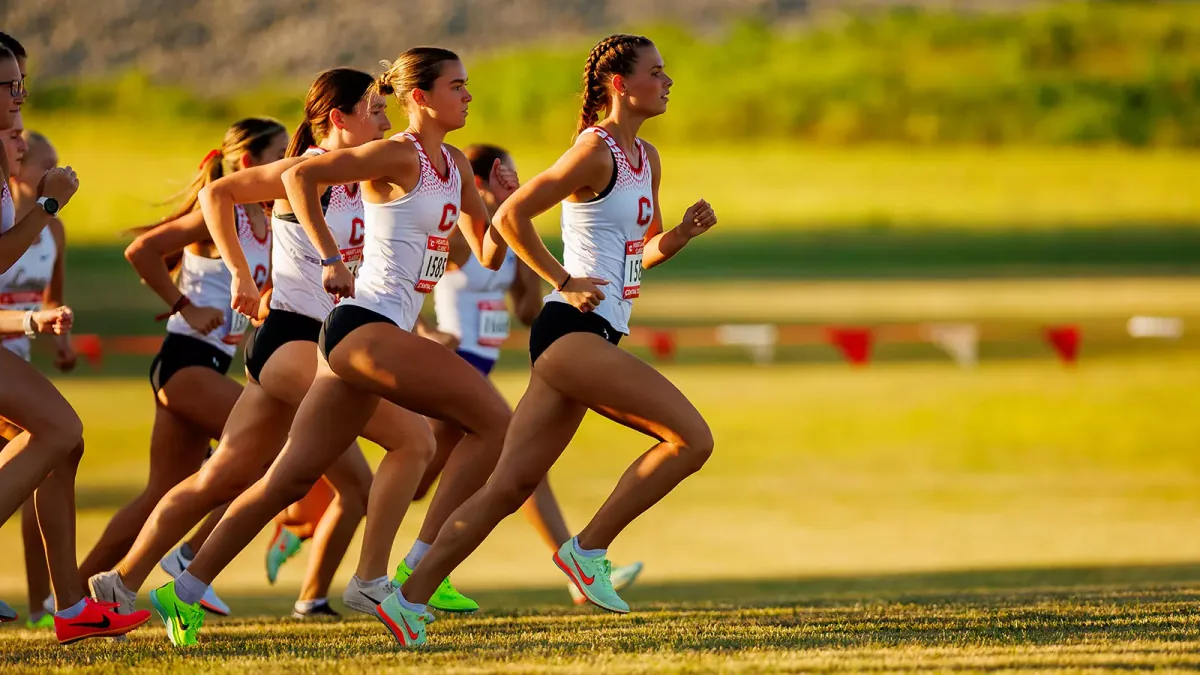
Cross country is a sport you watch from the finish line, so the runners families remember are the ones who broke the tape. It's easy to let those few names set the bar — to assume that anything short of winning your section meet means college running isn't really on the table.
The full count says otherwise. There are 1,388 women's cross country programs in the United States, spread across five levels of college sport and 53 states and territories, carrying about 10 runners each on average. That's a lot of teams, in a lot of places, recruiting a lot of different kinds of athletes.
One disappointing section meet rules out far less of this sport than it feels like: 1,388 teams across five levels recruit a far wider range of runners than the few who break the tape.
Best colleges
Search for best cross country colleges and you'll get a ranking. Recruiting doesn't work that way. The best cross country college is the one where your level, your grades, your budget, and a real shot at playing time all line up at once — and that school is different for every recruit.
So treat the sections below as filters, not a leaderboard. Each one sorts the field by a single thing that decides fit — how the divisions break down, how fast rosters turn over, what the degree is worth, and what a year really costs — and the full women's cross country directory lets you weigh them against your own priorities, program by program.
Before you narrow anything down, it helps to see every level at once. Use this report to map the programs that fit your runner, then turn that map into a recruiting plan with a clear order of who to contact and when.
Landscape
The biggest field of teams races off-broadcast.
The 1,388 programs don't pile up in Division I. The largest single group is Division III, with 406 programs — 29% of the sport. Division I follows with 362 programs (26%), then Division II with 286 (21%). The two-year junior colleges (JUCO) add 220 programs (16%), and the NAIA — a separate association of mostly smaller four-year schools — accounts for 114 (8%).
Put plainly: roughly three-quarters of women's cross country happens somewhere other than D1. Those programs aren't a consolation prize; they're the body of the sport, and where most college runners actually end up. The levels a family has heard of least are, statistically, the ones most likely to fit.
Read the shares as a place to start, not a ranking. A D3 program and a D1 program can each be the right home for a runner. They differ in scholarships, schedule, and feel — not in whether the running counts.
Teams follow people and colleges, so the populous states carry the most. California leads with 127, then New York with 107 and Pennsylvania with 94. Illinois and Texas each have 60, with Massachusetts (55), Michigan (50), and North Carolina (50) just behind.
The five biggest states hold about 32% of all programs between them — concentrated, but not so tightly that a runner outside them is shut out. For your family, distance is a practical dial: how far you're willing to drive widens or narrows the list before a single time or grade enters the picture. Settle that early, because it frames everything after.
Roster size
Lean packs that reopen each fall.
A cross country team races on a lineup, not a depth chart. Only the top five runners score at a meet, with a couple more in support, so rosters stay small. Across the sport the average is about 10 runners, but it rises with the level: D1 carries roughly 15.6 on average (median 14), D3 about 12, D2 about 11.7, the NAIA around 9.7, and JUCO the smallest at 6.2.
A small roster can read as a closed door. It isn't, because seniors graduate every year and a coach has to refill those places. To picture the yearly openings, divide a roster by four — about how long a runner stays — which lands near 3.9 spots a year at the typical D1 program, 3 at D3, and 2.9 at D2. JUCO turns over on a two-year clock, so its smaller squads still open about 3.1 a year.
Summed up, the room is real: roughly 1,414 openings a year across D1 programs, 1,222 across D3, 836 at D2, 678 at JUCO, and 278 in the NAIA. One honest caveat — these are estimates of natural turnover, not vacancies a coach has confirmed to you. A roster spot existing isn't the same as a coach recruiting for it. But the math shows far more annual room than a 10-runner squad lets on.
| Division | Programs | Avg roster | Open spots, total | Open spots, pr. program |
|---|---|---|---|---|
| D1 | 362 | 15.6 | 1,414/year | 3.9/year |
| D2 | 286 | 11.7 | 836/year | 2.9/year |
| D3 | 406 | 12.0 | 1,222/year | 3.0/year |
| NAIA | 114 | 9.7 | 278/year | 2.4/year |
| JUCO | 220 | 6.2 | 678/year | 3.1/year |
Averages flatten the real spread. Within a single division, rosters swing hard: a D1 like Saint Mary's College of California carries 35 runners while several D1 programs field fewer than ten, and the same gap repeats at every level. A deep squad isn't automatically more opportunity — it can mean more bodies chasing the same five scoring spots. The number worth checking is a specific program's roster against the size of its last recruiting class.
Best cross country roster opportunities, by division
| Program | Roster |
|---|---|
| Saint Mary's College of California West Coast Conference | 35 |
| University of California-Irvine Big West Conference | 31 |
| Northwestern University Big Ten Conference | 25 |
| University of Tulsa American Conference | 25 |
| East Tennessee State University Southern Conference | 25 |
| Brown University The Ivy League | 24 |
| University of Delaware Conference USA | 22 |
| Santa Clara University West Coast Conference | 21 |
| Merrimack College Metro Atlantic Athletic Conference | 21 |
| Siena College Metro Atlantic Athletic Conference | 21 |
Academics
Demanding academics sit behind the line, top to bottom.
If you're weighing the running against the schooling, the reassuring part is that academic strength doesn't sort neatly by division. Graduation rate — the share of students who finish their degree — averages about 66% at D1 programs and 64% at D3, nearly even. D2 sits around 50%, the NAIA near 43%, and JUCO at 36%, partly because two-year colleges are built as a step toward transfer rather than a finish line.
First-year retention — how many freshmen come back for a second year, an early read on whether students are thriving — tracks the same shape: about 82% at D1, 78% at D3, 72% at D2. Earnings a few years after college land near $52,117 at D1 and $50,084 at D3, again close, with D2 around $43,820 and the NAIA around $42,463.
The standouts sharpen the point. Among D1 programs, Harvard graduates 98% of its students and Stanford's alumni earn about $102,887 a few years out. The same caliber sits well below the D1 line: at D3, MIT graduates 96% and Caltech graduates 94% with alumni earning around $132,140 — the highest figure in the sport. Even in the NAIA, Soka University of America graduates 92%. A respected degree isn't something a runner gives up by choosing a smaller level; it turns up across all of them.
Best academic cross country colleges, by division
| Program | Acceptance rate | Graduation rate | Median earnings |
|---|---|---|---|
| Harvard University The Ivy League | 4% | 98% | $99,572 |
| University of Pennsylvania The Ivy League | 5% | 97% | $90,555 |
| Stanford University Atlantic Coast Conference | 4% | 92% | $102,887 |
| Columbia University in the City of New York The Ivy League | 4% | 96% | $88,535 |
| Princeton University The Ivy League | 5% | 98% | $87,815 |
| Cornell University The Ivy League | 9% | 95% | $87,830 |
| Duke University Atlantic Coast Conference | 6% | 97% | $85,792 |
| Dartmouth College The Ivy League | 5% | 96% | $82,541 |
| Yale University The Ivy League | 4% | 96% | $81,765 |
| University of Notre Dame Atlantic Coast Conference | 11% | 95% | $86,210 |
Cost
Tuition hinges on who backs the school, not where it runs.
The number that decides the most for a family is net price — what you actually pay per year after grants and aid, not the published sticker. And net price answers to one thing above all: whether a school is public (state-funded) or private. Across the sport, public programs average $13,102 a year after aid; private ones average $26,320. That spread is wider than the gap between any two divisions.
The same split holds inside each level. At D1, a public school averages $16,024 against a private school's $31,324; at D3, it's $15,833 versus $26,968. So a state university — whether it races at D1 or D3 — will usually cost a family less than a private college down the road. The division on the jersey tells you very little about the bill.
The overall range runs wide. JUCO is the cheapest level on average at $8,638 a year, while D3 averages the most at $24,741, pulled up by how many D3 schools are private. The lesson isn't that one level is cheap and another dear; it's that you have to price each program on its own terms, by who funds it.
Average net price per year, after grant and scholarship aid
There's a quiet assumption that the cheap option is the lesser one. The programs below in each division are the counter-evidence — the lowest net prices after aid, almost all of them public. At D1, The University of Texas Rio Grande Valley runs about $5,282 a year and the University of New Mexico about $6,347; at D3, the CUNY schools cluster near the bottom of the bill, with Lehman College around $3,961. State funding, not a weaker school, is usually what's behind a low net price — so these are worth pairing against graduation rate before you rank them.
Best-value cross country colleges, by division
| Program | Net price | Graduation rate |
|---|---|---|
| The University of Texas Rio Grande Valley Southland Conference | $5,282 | 51% |
| University of New Mexico-Main Campus Mountain West Conference | $6,347 | 54% |
| California State University-Bakersfield Big West Conference | $6,489 | 50% |
| California State University-Fullerton Big West Conference | $7,064 | 70% |
| California State University-Northridge Big West Conference | $7,536 | 57% |
| California State University-Fresno Mountain West Conference | $7,834 | 57% |
| Marshall University Sun Belt Conference | $8,076 | 51% |
| Utah Valley University Western Athletic Conference | $8,721 | 40% |
| Norfolk State University Mid-Eastern Athletic Conf. | $9,124 | 39% |
| Northern Kentucky University Horizon League | $9,211 | 54% |
Net price, graduation rate, and roster turnover all matter, but only when you weigh them together for your runner. Build a recruiting plan that scores each program on what it actually offers your family — not on the level it happens to compete in.
Resources
A big team budget rarely means a big scholarship.
A program's spending splits in two: athletic scholarships, the aid that goes straight to athletes, and other costs — coaching, travel, gear, and everything else it takes to run a team. For women's cross country, the scholarship side is modest next to the revenue sports, and it shrinks fast as you move down from D1.
One rule shapes the whole picture: Division III awards no athletic scholarships at all, by rule. A D3 program's entire reported spend — about $41,931 at the average — goes to other costs, never to athletic aid. So if a D3 coach is recruiting your runner, the conversation is about academic aid and admissions, not an athletic offer. That's not a catch; it's how the level works, and it's worth knowing before the first call.
Among the levels that do fund athletes, the drop is steep. The average D1 program reports about $308,289 in scholarships; D2 about $80,746, the NAIA about $75,800, and JUCO about $24,575. Notice that the NAIA nearly matches D2 on scholarship dollars despite being a far smaller slice of the sport — reason enough not to write off the NAIA when aid matters to your family.
Average spending per year, by division
Dividing a program's athletic aid by its roster gives a rough sense of how far the money stretches per spot. D1 leads by a wide margin at about $19,225 per roster spot. Below it the figure falls off sharply: the NAIA averages around $7,747, D2 about $6,839, and JUCO about $3,539. D3, awarding no athletic aid, has none to divide. The plain takeaway for your family is that athletic money is densest at D1 and spread thin everywhere else, so 'we have scholarships' means very different things at different levels.
Average athletic aid per roster spot, by division
These are the heaviest spenders in each division — the programs putting the most into their women's cross country each year. Total spend is the whole operation; the scholarship column shows how much of it reaches runners directly, the line between a travel-and-coaching budget and a scholarship-first one (and at D3, which awards no athletic aid, that column is blank by design). At the D1 top, Northwestern University reports about $1.28 million in total spend, nearly all of it scholarships. Worth noticing how the levels differ: at the NAIA top, Savannah College of Art and Design's roughly $650,025 out-spends most of Division I.
Big budgets buy deeper rosters, more travel, and stronger coaching — but they describe a program's resources, not whether it's the right place for your runner to spend four years.
Best-resourced cross country programs, by division
| Program | Total spend | Scholarships |
|---|---|---|
| Northwestern University Big Ten Conference | $1,275,700 | $1,274,370 |
| Stanford University Atlantic Coast Conference | $878,861 | $839,532 |
| Saint Mary's College of California West Coast Conference | $647,419 | $693,916 |
| Merrimack College Metro Atlantic Athletic Conference | $551,847 | $432,424 |
| Loyola Marymount University West Coast Conference | $525,709 | $595,754 |
| University of Tulsa American Conference | $483,962 | $811,391 |
| Seton Hall University BIG EAST Conference | $452,901 | $640,805 |
| Hampton University Coastal Athletic Association | $427,901 | $122,464 |
| Northern Illinois University Mid-American Conference | $402,374 | $154,446 |
| University of Delaware Conference USA | $393,098 | $462,629 |
So spending sorts the sport one way, and fit sorts it another. A program with a large budget and one with a small budget can each be the place a runner improves most and graduates happiest. The numbers tell you what a program has; only your runner's needs tell you whether it matches.
Conclusion
Step back and the shape of women's cross country is steadier than the belief most families start with. There are 1,388 programs across five levels, the largest of them outside D1, opening a few thousand spots a year between them. Strong degrees, fair prices, and real coaching turn up at every level, not just the one you catch on television.
So the work isn't proving your runner belongs at some single tier. It's matching her — the times she's running, the schooling she wants, what your family can pay — against the programs where those line up. The data narrows a field of 1,388 into a real list; it can't tell you which name on that list will feel like home.
Treat this report as the map and the next move as yours. Look past the few programs you already know, weigh each one on price, degree, and roster room, and start the conversations early. The runners who land well are the ones who looked widest and chose deliberately.
A list of programs isn't a plan yet. Build a recruiting plan that ranks the programs that fit your runner, sets the order to contact coaches, and keeps the timing on track — so the search stays grounded in what the data actually shows.
Methodology
Roster sizes and program finances come from the federal Equity in Athletics Data Analysis (EADA) reports, which colleges file each year — the source for the average rosters, the estimated yearly openings, and the scholarship and total-spend figures by division. Cost, graduation rate, first-year retention, post-college earnings, and acceptance rate come from the U.S. Department of Education's College Scorecard and IPEDS, the standard national datasets for what a year costs and how students fare.
Every figure is grouped within women's cross country and by division (D1, D2, D3, NAIA, and JUCO), so comparisons stay inside the sport rather than across unrelated ones. Estimated openings divide a roster by four — roughly how long a runner stays — and by two for JUCO's two-year cycle; they reflect natural turnover, not vacancies a coach has confirmed. Where a school reported no value for a metric, it's left out of that figure rather than counted as zero. Figures reflect the most recent reporting available as of the 2025–26 cycle.
U.S. Department of Education. Athletic participation and program finances, filed annually by every college.
U.S. Department of Education. Cost, graduation, earnings, and admissions data.
Official season records and results for NCAA D1, D2, and D3.